Testing season is coming! I have a confession to make. I love testing! I love taking tests, giving tests, and getting results. The concrete measurements fulfill something in me. To get a rank and measure of progress can not only be reassuring, but it can be useful! And if a test involves filling in those bubbles, that's an extra special kind of fun.
As a parent and teacher, I've been known to give a sight word vocabulary test using the SORT (which they trained us to use in college) every six months when my child's reading was really exploding. Using that test I would get a grade level year and month for my child's vocabulary (ex. 3.1 equals third grade, first month). I like to be able to look at a book, find out the level, and be able to get a good idea if it will be easy or hard for my child to read. Independent books should be at or slightly below level, instructional books should be slightly above level so as not to be overly frustrating but provide a challenge, and read-aloud books should generally be above level. To find out the reading level of a book, the Accelerated Reader program has leveled many books, but there are other measurement systems out there and many easy readers at your library will have the reading level printed on the back of the book.
Now that my son is a proficient reader, he often amazes me at what he can read. Sometimes I begin reading a book aloud and he can't wait for me to continue so he reads on his own. I will call up a book quiz on Book Adventure.com to find out that he can pass the comprehension test with no problem. There are other sources of book quizzes. The Magic Tree House website has comprehension quizzes available for the books in that series. Please comment if you know of others. Like I said, I love tests! They help me to be able to know for sure if my child understood what he read when he is reading on his own.
My five-year-old also surprises me with the words that she can read as I help her decode an Easter card or preschool morning message. This week at school she had to answer, "Do you want the snow to be gone?" "Yes, no, or maybe." That test question was an easy one. The answer was an emphatic "yes!"
Showing posts with label vocabulary. Show all posts
Showing posts with label vocabulary. Show all posts
Wednesday, March 27, 2013

Monday, January 21, 2013
Happy Martin Luther King Day
I love Martin Luther King Day. While all the other kids in our area have the day off of school, my homeschooler announces to our pastor in front of church during children's message that homeschoolers never get days off. Good boy! Today is certainly not one that I want to take off. Celebrating an important historical figure and role model as Martin Luther King Jr. is something I want to concentrate on in our schooling. Today we read books about Martin Luther King. We took turns reading and listening. We learned a LOT of new vocabulary. Here are some of the titles I especially enjoy:

You can tell Dr. King was an inspiring man by the art work he inspired people to create. The illustrations in these books are incredible. The Story of Ruby Bridges is a powerful one for young children. She was a very brave little first grader during a difficult time in the civil rights struggle. Matthew and Tilly is a great book for young ones. This story is the realization of Dr. King's dream. A little black girl and a little white boy are best friends, but it talks about friendship, anger and forgiveness. These are all very immediate topics for young children when the issue of segregation is thankfully so foreign to them. Martin Luther King day is the perfect opportunity to talk about the many shades of skin color and how we should be kind to everyone and get to know them without worrying about what they look like on the outside. These books are very applicable to our lives today.
My eight-year-old learned a lot of new vocabulary words today when we read the I Have a Dream speech. I'm sure he has heard some of them before, but you need multiple hearings to really cement new words into your vocabulary. Words like emancipation, poverty, prosperity, segregation, negro, manacles, divinity and reverend are difficult words that he will very likely not see again... until next year.
 |
| Center book title |

You can tell Dr. King was an inspiring man by the art work he inspired people to create. The illustrations in these books are incredible. The Story of Ruby Bridges is a powerful one for young children. She was a very brave little first grader during a difficult time in the civil rights struggle. Matthew and Tilly is a great book for young ones. This story is the realization of Dr. King's dream. A little black girl and a little white boy are best friends, but it talks about friendship, anger and forgiveness. These are all very immediate topics for young children when the issue of segregation is thankfully so foreign to them. Martin Luther King day is the perfect opportunity to talk about the many shades of skin color and how we should be kind to everyone and get to know them without worrying about what they look like on the outside. These books are very applicable to our lives today.
My eight-year-old learned a lot of new vocabulary words today when we read the I Have a Dream speech. I'm sure he has heard some of them before, but you need multiple hearings to really cement new words into your vocabulary. Words like emancipation, poverty, prosperity, segregation, negro, manacles, divinity and reverend are difficult words that he will very likely not see again... until next year.
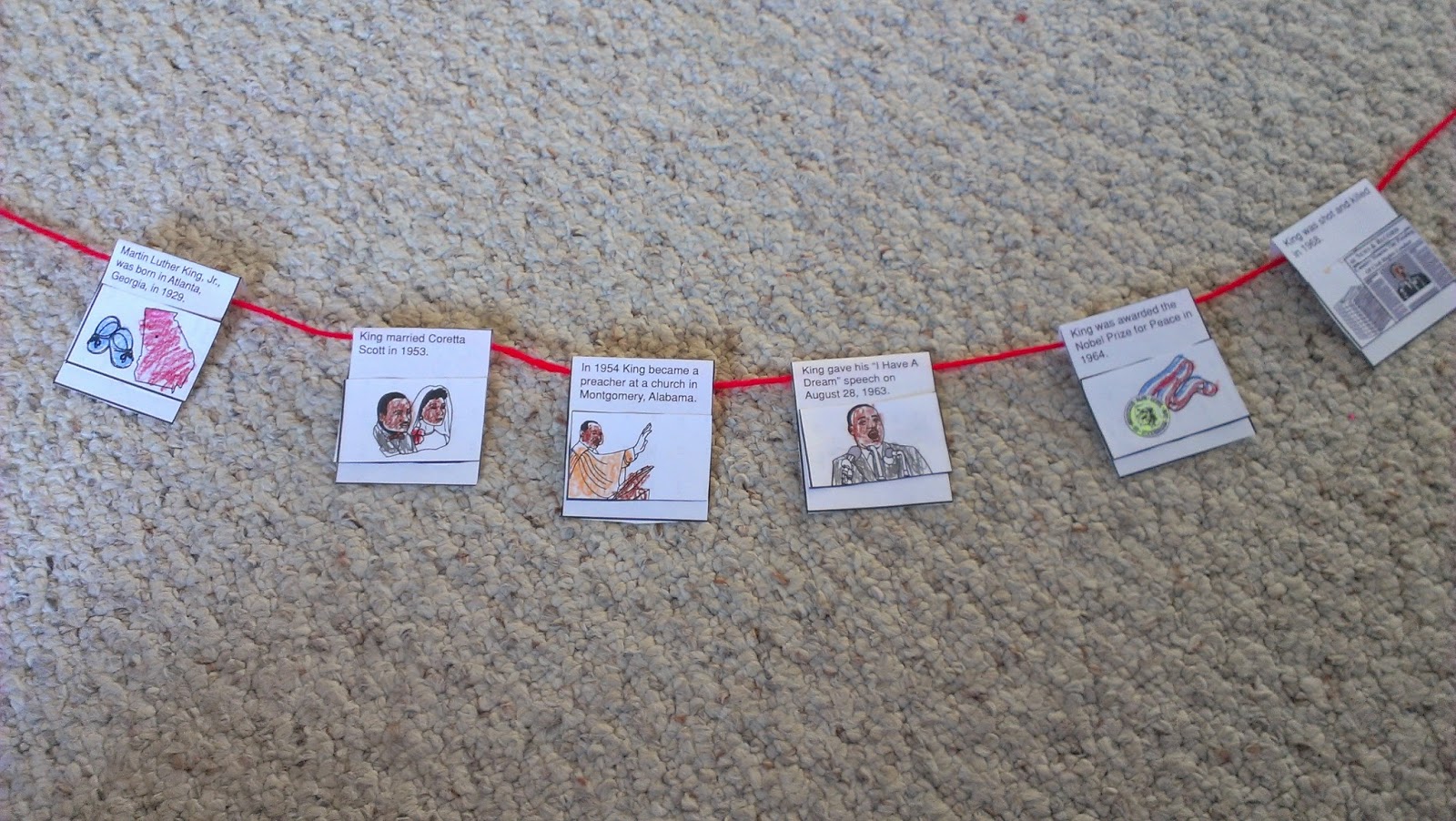 |
| MLK timeline activity from the Mailbox |
Sunday, September 30, 2012
Testing... testing
We recently completed the Peabody test, our standardized test requirement for homeschool. Something that really struck me this time in light of this blog was that Spelling was entirely separate from Reading on this test. Thinking back, this also is true of other tests we have used. Spelling is such a fascinating sport. I call it a sport because I really enjoy the Scripps National Spelling Bee and got a real kick out of the documentary Spellbound. It is interesting to me how these master spellers study the history and origin of words in the English language and how this history is reflected in phoneme patterns. These teenagers have spent countless hours of intense study on words. Then a few days ago a fellow homeschooling mom posted a link to this video on Facebook. It went along with my train of thought perfectly!
But back to the Peabody, the two Reading sections on the test are Vocabulary and Comprehension. Understanding of phonics is definitely important for the vocabulary section. If reading were a three-legged table, phonics and phonemic awareness are two very important legs of the table. But they cannot hold up the table alone. I watched my son take the Peabody for the second year in a row. For the second year in a row, he blew me away on the vocabulary section. And it isn't his score that blows me away. It is his process that fascinates me. It goes something like this: look at the word, sound out the syllables, think if they are close to any words in his vocabulary. Often the words on the test are difficult to sound out. The only way a child would know the word is if it is already a word they have heard. This is the same in reading.
I attended a wonderful conference where I had a great discussion with a reading tutor who has been teaching reading for about 1,000 years (I don't know her true age, but I'm fairly certain that she would agree with me based on our short discussion ;)) She applies a similar philosophy to the one used by foreign language learning programs and that is "hear it, speak it, write it, read it." Children need to hear a word before they can say a word and they need to be able to say the word before they can read it. I would put the writing part last, especially with young children in their native language.
Good reading skills definitely help with writing and spelling. I'm sure we've all spelled a word on paper and looked at it to see if it "looks right." Even spelling bee champs do this mentally. Reading comprehension also involves creating a mental picture of what you are reading, especially in the Peabody test. Just as picture books help youngsters with comprehension, creating mental pictures helps increase comprehension. It was interesting to watch my son analyze the pictures in the Peabody test to see which one matched the section he had just read. I could tell which vocabulary words got him hung up by which of the four pictures he chose. I could also tell when he struggled to hold his mental picture in his head and when looking at the pictures.
Testing is a fascinating process. It doesn't tell all, but it tells an awful lot. And not necessarily about the subjects it is testing. It may tell more about a child's attention to detail and attention span than about their spelling skills. It may ask about things they haven't covered well or things that are especially easy for them. As a parent, I get more value out of the process than the final result. Which is the same reason I enjoy reading. The process IS the final result: enjoying a book and learning what it has to teach you. If it helps improve test scores, that's just a bonus.
But back to the Peabody, the two Reading sections on the test are Vocabulary and Comprehension. Understanding of phonics is definitely important for the vocabulary section. If reading were a three-legged table, phonics and phonemic awareness are two very important legs of the table. But they cannot hold up the table alone. I watched my son take the Peabody for the second year in a row. For the second year in a row, he blew me away on the vocabulary section. And it isn't his score that blows me away. It is his process that fascinates me. It goes something like this: look at the word, sound out the syllables, think if they are close to any words in his vocabulary. Often the words on the test are difficult to sound out. The only way a child would know the word is if it is already a word they have heard. This is the same in reading.
I attended a wonderful conference where I had a great discussion with a reading tutor who has been teaching reading for about 1,000 years (I don't know her true age, but I'm fairly certain that she would agree with me based on our short discussion ;)) She applies a similar philosophy to the one used by foreign language learning programs and that is "hear it, speak it, write it, read it." Children need to hear a word before they can say a word and they need to be able to say the word before they can read it. I would put the writing part last, especially with young children in their native language.
Good reading skills definitely help with writing and spelling. I'm sure we've all spelled a word on paper and looked at it to see if it "looks right." Even spelling bee champs do this mentally. Reading comprehension also involves creating a mental picture of what you are reading, especially in the Peabody test. Just as picture books help youngsters with comprehension, creating mental pictures helps increase comprehension. It was interesting to watch my son analyze the pictures in the Peabody test to see which one matched the section he had just read. I could tell which vocabulary words got him hung up by which of the four pictures he chose. I could also tell when he struggled to hold his mental picture in his head and when looking at the pictures.
Testing is a fascinating process. It doesn't tell all, but it tells an awful lot. And not necessarily about the subjects it is testing. It may tell more about a child's attention to detail and attention span than about their spelling skills. It may ask about things they haven't covered well or things that are especially easy for them. As a parent, I get more value out of the process than the final result. Which is the same reason I enjoy reading. The process IS the final result: enjoying a book and learning what it has to teach you. If it helps improve test scores, that's just a bonus.
Tuesday, September 25, 2012
Mom, how do you spell DOUGH?
I find writing even better than reading for teaching phonics. It's a slower process, which allows more time to think about letter sounds and talk about rules without getting frustrated and losing comprehension. Here are two examples from our morning:
My 4-year-old daughter is very motivated to learn to read and write at the moment. This is not always convenient, but I try to drop what I'm doing to sit and help her when she is interested. Knowing that reading and writing get me to stop what I'm doing and pay attention to them gives my kids a positive attention-getting strategy; I think that's another reason my kids love to read and write. Today she was writing something about a wizard whose wand didn't work (today's letter focus suddenly became W). Instead of just telling her the letters when she asks me how to spell something, I say the sounds slowly and try to help her remember which letter makes that sound. The process of remembering how to write a letter requires a different kind of recall than seeing the letter and knowing the name and sound. This type of practice cements the letters and sounds in the young reader's brain. Writing also helps set sight words in concrete. As kids get more confident in remembering the letters and sounds, it is fun to have them try to sound out words on their own and praise them for how many sounds they recognized, even if it's just the first sound or the Z in the middle of WIZARD.
My 8-year-old son d-r-a-g-s his feet when I ask him to write. I try to give him writing projects that he will enjoy, but I often miss the mark. Writing about his pet cockroaches or his team of super dogs (stuffed animals) have been winning topics. Writing about field trips or what he learned from the Disney Imagineering science video (today's project) tend to be more of a struggle, but I know they are important for retaining what he has learned. During today's journal writing activity, he asked me how to spell DOUGH. I had to ask, "Which kind of dough... doe, do or dough?" :) Then he asked me how to spell HIGH, qualifying it by saying he knew how to spell HI. These experiences are rich vocabulary builders, opportunities to learn about parts of speech, and discover more complex phoneme patterns. The way I choose to do spelling is to take the words that he struggles with and turn them into his spelling words, adding other words that may share the same pattern. For example, next week's spelling list might include HIGH, LIGHT, SIGH, FLIGHT, DOUGH, THOUGH, DOE, WOE. (Woe would be fun to use in a sentence. "The work my mom gave me filled me with woe." I think I'll have to use that.)
Monday, September 24, 2012
Bee Gee
This morning my son was reading aloud to me from the Star Wars Craft book I had picked up at the library (that book could be an art curriculum for an entire school year) and he got to a step that included "Bee Gee" fabric. Hmmm... I thought... quickly ruling out the idea of 60s rock band patterned fabric, I realized he meant BEIGE! Oh, yes, good old beige. We've had to drill this new word all morning, as he'd obviously been reading it wrong to himself for a while. This reinforced to me the idea of having your child read aloud to you or to their siblings while you are listening, even when they are fluent readers and it seems easy enough to let them read silently to themselves. And proves once again that sounding out, while helpful, has its limitations.
Dictionary skills can come in very handy when children get to higher reading levels. When they are reading more complex texts, they will encounter difficult words that are unfamiliar. A lot of online dictionaries even have an audio pronunciation that you can listen to if the dictionary symbols are difficult. Reading is a great way to expand vocabularies at a higher reading level because books and news articles often use words that are not used in ordinary conversation.
Here is a handy resource if you'd like to know more about phonemic awareness (knowing the sounds that are made by combinations of letters). There are 26 letters in the English language, but check out this list of sounds. http://www.edalive.com/wp-content/uploads/2010/09/BTRS-Phonemic-Foundation.pdf
Dictionary skills can come in very handy when children get to higher reading levels. When they are reading more complex texts, they will encounter difficult words that are unfamiliar. A lot of online dictionaries even have an audio pronunciation that you can listen to if the dictionary symbols are difficult. Reading is a great way to expand vocabularies at a higher reading level because books and news articles often use words that are not used in ordinary conversation.
Here is a handy resource if you'd like to know more about phonemic awareness (knowing the sounds that are made by combinations of letters). There are 26 letters in the English language, but check out this list of sounds. http://www.edalive.com/wp-content/uploads/2010/09/BTRS-Phonemic-Foundation.pdf
Sunday, September 23, 2012
Homework is best
Why do schools give homework? Because they know students benefit from one-on-one instruction and parent involvement in their learning. This is the number one predictor of success. It is even the predictor before they enter school. Students who have vocabularies of 10,000 words when entering kindergarten are much more successful long term than children with smaller vocabularies. Children build their vocabularies by being read to, talked to, and played with by their parents. The amount of time does matter. The 10,000 word vocabularies are found in children who have spent an hour a day reading. And growth is exponential. The larger a vocabulary, the more it grows. It is truly exciting!
Friday, September 14, 2012
That Darn English Language
Have you been singing the ABC song since your baby could sing? Have you been looking for letters, pointing them out and naming them? How about practicing the sounds they make? Wonderful! This is beginning phonics! Maybe you've even been sounding out simple words: ME, CAT, DOG, MOM, DAD. Great! You can then look for those simple words in books and have your child read them. You can even find many books that are written almost solely with simple words that your child can sound out. (Often these books are terribly boring and make no sense, so beware!) These are very important reading skills. Your child may then begin learning combination sounds like TH, CH, SH, OO, and the silent E. Amazing! There is so much to learn!
Then come even more complicated rules and all the exceptions to those rules. Gee whiz! Could we have a more complicated language? English is one of the more difficult languages to learn because of its complexity and the sheer number of words that have variations in meaning, are spelled the same but pronounced differently, or sound the same but are spelled differently. I know you know all of these things because you are reading this right now. And you don't need to think about any of those rules, do you? That is because you are a fluent reader. You have been speaking and reading English long enough that you no longer need the rules. Your brain focuses mainly on the beginning and ending sounds and context clues when reading.
But back to our young readers... how do we help them with the craziness of the English language? I cannot recommend the "sound it out" approach. Yes, it can work. It is obviously helpful to know the general rules and sounds that letters make. But this strategy for figuring out unfamiliar words quickly becomes very frustrating for the child and for the parent or teacher! It is usually more effective to memorize some of the most common sight words (remember those books they memorized from infancy). Then when the child comes to a word they don't know, have the child guess, based on the beginning and/or ending sound of the word and, most importantly, the context of what they are reading. This means they have to be thinking about what they are reading and gaining meaning from the words, not simply decoding sounds. And gaining meaning is the entire goal of reading!
This is also why I advocate turn taking while reading. Remember round robin reading as a child when you went around the classroom taking turns reading a sentence or paragraph? Maybe you were the slow reader and hated reading aloud or maybe you were the fluent reader and wanted to read the entire thing so you didn't have to wait for the slower readers. Whichever child you identify with, the idea behind this approach is that the more fluent readers will model for the others. They will keep the flow of the text moving and hopefully everyone is listening and gaining meaning. The slower readers still get practice reading aloud without the frustration of having to read the entire text. Parents can take turns reading with their child to gain the same effect in a more safe, comforting environment.
There are huge benefits to continuing to read more challenging material aloud to your child for many years to come. In college, I loved when our Children's Literature teacher would sit us all on the floor and read wonderful picture books to us. I remember the tears in my eyes as I listened to her read books like "The Dead Bird" and "Pink and Say." Aside from sheer enjoyment, listening expands a child's vocabulary as they hear unfamiliar words. When they encounter these words in their own reading, they will be prepared for them. Audio books can be a nice tool if you do not feel comfortable or confident reading aloud. You can also take advantage of story time at your local library or bookstore.
Heading to your library or bookstore can double as an outing that will bring up topics for conversation. Talking with your child is just as important to reading success as reading aloud. The reason reading to children is so powerful is that books tend to use new words that we don't encounter in everyday situations. So in that vein, you can help your child's reading success by bringing different vocabulary words into conversation or imaginary play. Explore the world, get into new situations, visit unique places: museums, fairs, fire stations, the post office... exposing your child to new terminology and giving them hands-on context for these unfamiliar words. Have them tell someone about their experiences to reinforce their learning. Later, when they are reading to themselves, they will know those words based on their beginning and ending sounds and the context in which they appear.
Then come even more complicated rules and all the exceptions to those rules. Gee whiz! Could we have a more complicated language? English is one of the more difficult languages to learn because of its complexity and the sheer number of words that have variations in meaning, are spelled the same but pronounced differently, or sound the same but are spelled differently. I know you know all of these things because you are reading this right now. And you don't need to think about any of those rules, do you? That is because you are a fluent reader. You have been speaking and reading English long enough that you no longer need the rules. Your brain focuses mainly on the beginning and ending sounds and context clues when reading.
But back to our young readers... how do we help them with the craziness of the English language? I cannot recommend the "sound it out" approach. Yes, it can work. It is obviously helpful to know the general rules and sounds that letters make. But this strategy for figuring out unfamiliar words quickly becomes very frustrating for the child and for the parent or teacher! It is usually more effective to memorize some of the most common sight words (remember those books they memorized from infancy). Then when the child comes to a word they don't know, have the child guess, based on the beginning and/or ending sound of the word and, most importantly, the context of what they are reading. This means they have to be thinking about what they are reading and gaining meaning from the words, not simply decoding sounds. And gaining meaning is the entire goal of reading!
This is also why I advocate turn taking while reading. Remember round robin reading as a child when you went around the classroom taking turns reading a sentence or paragraph? Maybe you were the slow reader and hated reading aloud or maybe you were the fluent reader and wanted to read the entire thing so you didn't have to wait for the slower readers. Whichever child you identify with, the idea behind this approach is that the more fluent readers will model for the others. They will keep the flow of the text moving and hopefully everyone is listening and gaining meaning. The slower readers still get practice reading aloud without the frustration of having to read the entire text. Parents can take turns reading with their child to gain the same effect in a more safe, comforting environment.
There are huge benefits to continuing to read more challenging material aloud to your child for many years to come. In college, I loved when our Children's Literature teacher would sit us all on the floor and read wonderful picture books to us. I remember the tears in my eyes as I listened to her read books like "The Dead Bird" and "Pink and Say." Aside from sheer enjoyment, listening expands a child's vocabulary as they hear unfamiliar words. When they encounter these words in their own reading, they will be prepared for them. Audio books can be a nice tool if you do not feel comfortable or confident reading aloud. You can also take advantage of story time at your local library or bookstore.
Heading to your library or bookstore can double as an outing that will bring up topics for conversation. Talking with your child is just as important to reading success as reading aloud. The reason reading to children is so powerful is that books tend to use new words that we don't encounter in everyday situations. So in that vein, you can help your child's reading success by bringing different vocabulary words into conversation or imaginary play. Explore the world, get into new situations, visit unique places: museums, fairs, fire stations, the post office... exposing your child to new terminology and giving them hands-on context for these unfamiliar words. Have them tell someone about their experiences to reinforce their learning. Later, when they are reading to themselves, they will know those words based on their beginning and ending sounds and the context in which they appear.
Subscribe to:
Posts (Atom)