How do you feel about gimmicks? Gimmicks are often thought of as low quality, fleeting, trendy or even evil. On the other hand, the rules of the natural world and the growth of our bodies and minds are real and lasting. When these two forces collide, it can be incredibly powerful. Case in point:
National Geographic Angry Birds
I can't tell you how long my dear son spent looking at these books in Barnes and Noble yesterday and he didn't even think he learned anything despite the fact that these books are full of information about animal identification, habitat, geography and behavior. Thankfully, our local library has several books from this series in circulation. I will definitely be recommending it to gift givers this holiday season.
I am generally not a fan of gimmicks, but when used well, they can be great tools for helping children build important skills. I recommend that you check out trendy books and see if they meet your standards. You may be pleasantly surprised!
Saturday, August 31, 2013
Sunday, August 18, 2013
Always time for reading
My kids didn't win any prizes with their summer reading programs. They never turned in enough time sheets. But they certainly spent time reading! I treasure the moments when they are sitting side by side behind the couch with my son encouraging his sister to try new words. It sounds something like, "Do you want to be a teenager and not be able to read this?" I get a good chuckle out of his frustrations and appreciate his overall patience and honest encouragement. I'm often frustrated myself by having to pick up mountains of books for the thousandth time. Or when I need to say, "This really is the last one," my arms loaded with library books. On those busy days, when I need to be working on something or when we can't mess up the house because we just finished cleaning it, we turn to our trusty friends, books. I'm thankful for them. They are always waiting there on the shelf with plenty of time for us, even on the busiest of days.
Tuesday, July 2, 2013
Still here, reading
I hope you are enjoying the summer that finally arrived in my neck of the woods, where we call it our "neck of the woods." Summer is one of my favorite times for reading, probably stemming from a childhood of school vacations that allow for seemingly endless, uninterrupted hours to get lost in a good book. With all the summer activities available my kids, I have to be careful to guard their uninterrupted reading time. This week, after an especially fruitful trip to the library, during which I stumbled upon a chapter book entitled "Bug Boy," my son spent a solid three hours finishing the book cover to cover! (If you know my son, he plans to be an entomologist when he grows up, so this work of fiction about a boy who can turn into a bug was right up his alley.) If you have a Bug Boy or Bug Girl in your family, they may be interested in these titles by Carol Sonenklar. Or they may like a non-fiction book about bugs, which my son would typically read.
I also like summer for all the summer reading programs available. My kids can earn a free book at Barnes and Noble. They enter to win prizes at the local library. I'm sure there are many other summer reading programs that people could share in the comments. Incentive programs are wonderful, especially when they recognize the value of time spent listening to an adult read as equal to the time spent reading independently. Incentives can be just the ticket to get a reluctant reader motivated to put in the time necessary to discover a love for reading. But parents beware: incentives programs can just as easily squelch a spark of love that is ready to leap into a flame. If we make reading about an external goal and not about the enjoyment of the act of reading, we may be defeating the purpose. Two reading programs is really more than my kids want to do. They read a ton, but need reminders to fill in their time sheets and recording titles. And I'm okay with that. It means they get the point - reading is fun!
Wednesday, May 8, 2013
Books for taking turns
We just discovered a new series of easy reader books. Bear with me if you've already heard of them because they've obviously been around a while, but they are new to me. And they are fabulous! The series is We Both Read. Check out their website or search "we both read" on your library's search engine. These books have a parent's page on the left and a child's page on the right. They come in a range of levels.
The wonderful part about these books is how well they are written! The parent's page includes rich new vocabulary words for young readers. It helps the story move along for the youngster with a short attention span (the series includes non-fiction titles for yourboys non-fiction fans). The child's page uses common sight words. Some new words are introduced on the parent's page, then repeated often on the child's pages. The child's page also includes short passages with larger print. And yet (here is the tricky part), the text is still well written, matching the flow of the story.
We had so much fun with The Frog Prince last night that I absolutely had to share! It really kept my daughter motivated to continue reading even though she was tired and it was hard work. I kept saying, "We can put in a bookmark and finish tomorrow." But she dug deep and continued on. That's the sign of a good book!
I have come across other books that utilize this same concept in the past, but I find they are not usually well-written, enjoyable books to read. We will definitely be trying more books from this series. I noticed some of the books listed on the website (the "Elephant and Piggie" series and "You Read to Me, I'll Read to You") were also books I would recommend as fun for taking turns reading. Please add any additional suggestions in the comments! Happy Reading!
The wonderful part about these books is how well they are written! The parent's page includes rich new vocabulary words for young readers. It helps the story move along for the youngster with a short attention span (the series includes non-fiction titles for your
We had so much fun with The Frog Prince last night that I absolutely had to share! It really kept my daughter motivated to continue reading even though she was tired and it was hard work. I kept saying, "We can put in a bookmark and finish tomorrow." But she dug deep and continued on. That's the sign of a good book!
I have come across other books that utilize this same concept in the past, but I find they are not usually well-written, enjoyable books to read. We will definitely be trying more books from this series. I noticed some of the books listed on the website (the "Elephant and Piggie" series and "You Read to Me, I'll Read to You") were also books I would recommend as fun for taking turns reading. Please add any additional suggestions in the comments! Happy Reading!
Friday, April 26, 2013
Finding information
Why do you read? Reading has many purposes. We often have opportunities to model for our children reading for pleasure and for information. It is wonderful to see our children start to pick up books for fun. It is all the more exciting when they pick up books to find information.
There are innumerable ways we rely on reading for information. Looking up a new bug or finding a favorite recipe are examples. In our testing this week, there was a section about using resources like an atlas, dictionary, or index to search for desired information. Thankfully our family enjoys hunting for information, so this was a fairly easy section. As a side note, there was sure a lot of reading in the test, even in the math section.
My five-year-old confirmed again today that we start practicing information gathering skills from an early age at our house. She was doing an activity in her princess magazine. It was a list of four true and false questions. She brought it to me completed, proudly telling me she got all the answers right! I was in awe! The sentences were complicated and, while she has been surprising me with her rapidly growing reading proficiency, I couldn't believe she had actually read them! Then she confessed, "I didn't read them. I just circled random answers and then checked in the back. And I got them all right!" Way to use your resources, girl!
Wednesday, April 17, 2013
Classics
I enjoyed this short article from Reading Rainbow about the value of teaching children classic literature. I would expand on it to include that children also learn patterns in storytelling from classic literature. Many of the old fairy tales have been remixed and new versions appear or appear in other forms from countries around the world. There are Cinderella tales from many cultures. What a rich learning experience for children to compare and contrast these tales. It builds higher order thinking skills when you look for things that are the same and different between these stories. Then go one step further and write or tell your own version of a classic tale.
Books are always being written and new classics are born. I wouldn't be surprised if Horton's Miraculous Mechanisms is one of these. This is my son's favorite book this week. When he reads seven chapters in the middle of the night, I know the book is a winner!
What are your favorite classics? What new books do you predict will become classics? Add your thoughts in the comments!
Books are always being written and new classics are born. I wouldn't be surprised if Horton's Miraculous Mechanisms is one of these. This is my son's favorite book this week. When he reads seven chapters in the middle of the night, I know the book is a winner!
What are your favorite classics? What new books do you predict will become classics? Add your thoughts in the comments!
Thursday, March 28, 2013
Pattern and prediction
For those very beginning readers, books with patterns are great! I was reading the Mercer Mayer classic, "Just Go To Bed" with my five-year-old this afternoon. I really pushed her reading skills today. Two things that we relied on heavily during our reading was pattern and prediction. On each new page we first studied the illustrations. Looking to see what was happening in the pictures gave us a great head start to figuring out the words. Another big help was the repetition in the book. We would look back to find where we had read a word before to help us. (She has been known to do this on her own. We've been playing Draw Something, a smartphone app which is like Pictionary, and she went to find her Click magazine to find how to spell "nose" because she remembered she could find it there! How resourceful!) Between these two strategies and her base knowledge of phonics, she did great and was very proud.
Another fun strategy that I used when she started to get frustrated was using humor and word play. At one point the character dressed as a "bunny." When sounding out "bunny," I suggested funny things. I don't hesitate to use bathroom humor, so "butt" is not off limits :) That lightened the mood and gave her a spurt of energy to try reading a little longer. When we focus on prediction and making sense of what we are reading, we reinforce reading for understanding. Isn't that the ultimate goal?
(Note: I actually have a post from YESTERDAY, too! :) Go me!)
Another fun strategy that I used when she started to get frustrated was using humor and word play. At one point the character dressed as a "bunny." When sounding out "bunny," I suggested funny things. I don't hesitate to use bathroom humor, so "butt" is not off limits :) That lightened the mood and gave her a spurt of energy to try reading a little longer. When we focus on prediction and making sense of what we are reading, we reinforce reading for understanding. Isn't that the ultimate goal?
(Note: I actually have a post from YESTERDAY, too! :) Go me!)
Wednesday, March 27, 2013
Measuring progress
Testing season is coming! I have a confession to make. I love testing! I love taking tests, giving tests, and getting results. The concrete measurements fulfill something in me. To get a rank and measure of progress can not only be reassuring, but it can be useful! And if a test involves filling in those bubbles, that's an extra special kind of fun.
As a parent and teacher, I've been known to give a sight word vocabulary test using the SORT (which they trained us to use in college) every six months when my child's reading was really exploding. Using that test I would get a grade level year and month for my child's vocabulary (ex. 3.1 equals third grade, first month). I like to be able to look at a book, find out the level, and be able to get a good idea if it will be easy or hard for my child to read. Independent books should be at or slightly below level, instructional books should be slightly above level so as not to be overly frustrating but provide a challenge, and read-aloud books should generally be above level. To find out the reading level of a book, the Accelerated Reader program has leveled many books, but there are other measurement systems out there and many easy readers at your library will have the reading level printed on the back of the book.
Now that my son is a proficient reader, he often amazes me at what he can read. Sometimes I begin reading a book aloud and he can't wait for me to continue so he reads on his own. I will call up a book quiz on Book Adventure.com to find out that he can pass the comprehension test with no problem. There are other sources of book quizzes. The Magic Tree House website has comprehension quizzes available for the books in that series. Please comment if you know of others. Like I said, I love tests! They help me to be able to know for sure if my child understood what he read when he is reading on his own.
My five-year-old also surprises me with the words that she can read as I help her decode an Easter card or preschool morning message. This week at school she had to answer, "Do you want the snow to be gone?" "Yes, no, or maybe." That test question was an easy one. The answer was an emphatic "yes!"
As a parent and teacher, I've been known to give a sight word vocabulary test using the SORT (which they trained us to use in college) every six months when my child's reading was really exploding. Using that test I would get a grade level year and month for my child's vocabulary (ex. 3.1 equals third grade, first month). I like to be able to look at a book, find out the level, and be able to get a good idea if it will be easy or hard for my child to read. Independent books should be at or slightly below level, instructional books should be slightly above level so as not to be overly frustrating but provide a challenge, and read-aloud books should generally be above level. To find out the reading level of a book, the Accelerated Reader program has leveled many books, but there are other measurement systems out there and many easy readers at your library will have the reading level printed on the back of the book.
Now that my son is a proficient reader, he often amazes me at what he can read. Sometimes I begin reading a book aloud and he can't wait for me to continue so he reads on his own. I will call up a book quiz on Book Adventure.com to find out that he can pass the comprehension test with no problem. There are other sources of book quizzes. The Magic Tree House website has comprehension quizzes available for the books in that series. Please comment if you know of others. Like I said, I love tests! They help me to be able to know for sure if my child understood what he read when he is reading on his own.
My five-year-old also surprises me with the words that she can read as I help her decode an Easter card or preschool morning message. This week at school she had to answer, "Do you want the snow to be gone?" "Yes, no, or maybe." That test question was an easy one. The answer was an emphatic "yes!"
Labels:
comprehension,
decoding,
level,
test,
testing,
vocabulary
Thursday, February 7, 2013
I Got Schooled
Last night in a group of parents of preschoolers we were talking about literacy - a topic that I love, obviously. It so happened that there were several parents in the group who had older children with learning disabilities. So as I'm going along talking about laying a foundation for early reading, they were there to remind me that all this stuff I'm talking about doesn't work for all kids. It was an important reminder and I immediately knew that I needed to share it here. There really are a LOT of things that can interfere with a child's ability to read that are entirely out of a parent's control. They are also beyond the scope of most classroom teachers. They require experts. Psychologists, special education teachers, or learning coaches can help remedy these issues or help children work with the skills they do have so they can be successful. So if you have a young child who has no interest in learning to read and you really think it should be coming by now or an older child who is very frustrated because they can't read as well as they want to, don't hesitate. Get an evaluation done. With a proper diagnosis of the problem, steps can be taken to help your child be successful. Trust your instincts as a parent and if something feels wrong, don't wait. Get it looked into. Push your school district for testing if you need to push, but you shouldn't need to. A parent expressing a concern and asking specifically for testing should produce immediate results. The sooner your child feels successful as a reader, the sooner they will be on the path to independent learning.
Special note to homeschooling parents: Please don't feel intimidated by your school district. They want to help all children learn. They may encourage you to put your child into public school. It may be very difficult to hear. But bring as much support as you need to any meetings and, as always, don't sign anything you haven't read thoroughly and feel comfortable with. As an educator, you understand that information is power. Get the information. There are a whole range of services available to your child. As your child's teacher, you choose which resources to incorporate into their education. Just as all parents do.
Monday, January 21, 2013
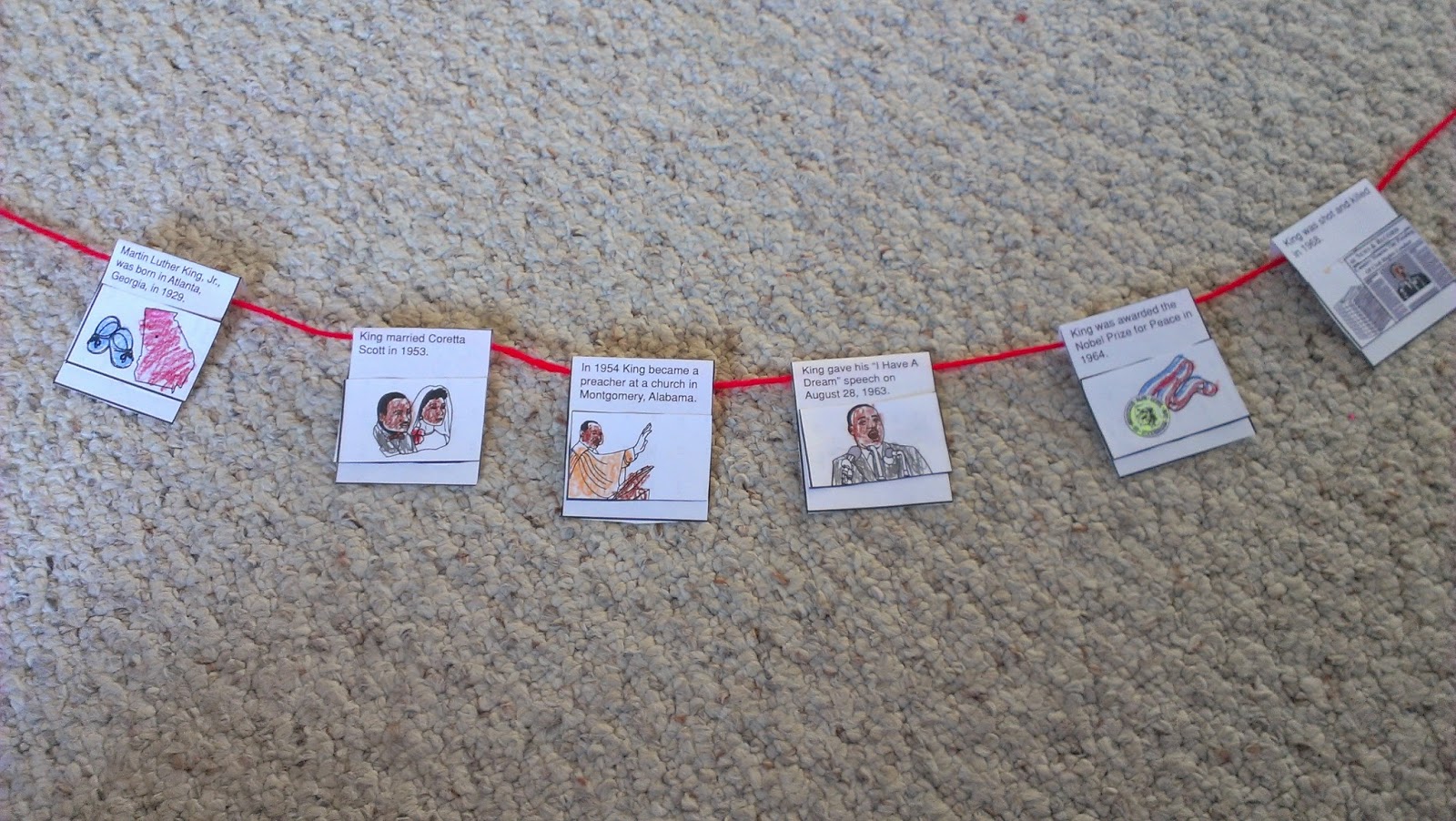
Happy Martin Luther King Day
I love Martin Luther King Day. While all the other kids in our area have the day off of school, my homeschooler announces to our pastor in front of church during children's message that homeschoolers never get days off. Good boy! Today is certainly not one that I want to take off. Celebrating an important historical figure and role model as Martin Luther King Jr. is something I want to concentrate on in our schooling. Today we read books about Martin Luther King. We took turns reading and listening. We learned a LOT of new vocabulary. Here are some of the titles I especially enjoy:

You can tell Dr. King was an inspiring man by the art work he inspired people to create. The illustrations in these books are incredible. The Story of Ruby Bridges is a powerful one for young children. She was a very brave little first grader during a difficult time in the civil rights struggle. Matthew and Tilly is a great book for young ones. This story is the realization of Dr. King's dream. A little black girl and a little white boy are best friends, but it talks about friendship, anger and forgiveness. These are all very immediate topics for young children when the issue of segregation is thankfully so foreign to them. Martin Luther King day is the perfect opportunity to talk about the many shades of skin color and how we should be kind to everyone and get to know them without worrying about what they look like on the outside. These books are very applicable to our lives today.
My eight-year-old learned a lot of new vocabulary words today when we read the I Have a Dream speech. I'm sure he has heard some of them before, but you need multiple hearings to really cement new words into your vocabulary. Words like emancipation, poverty, prosperity, segregation, negro, manacles, divinity and reverend are difficult words that he will very likely not see again... until next year.
![]() |
| Center book title |

You can tell Dr. King was an inspiring man by the art work he inspired people to create. The illustrations in these books are incredible. The Story of Ruby Bridges is a powerful one for young children. She was a very brave little first grader during a difficult time in the civil rights struggle. Matthew and Tilly is a great book for young ones. This story is the realization of Dr. King's dream. A little black girl and a little white boy are best friends, but it talks about friendship, anger and forgiveness. These are all very immediate topics for young children when the issue of segregation is thankfully so foreign to them. Martin Luther King day is the perfect opportunity to talk about the many shades of skin color and how we should be kind to everyone and get to know them without worrying about what they look like on the outside. These books are very applicable to our lives today.
My eight-year-old learned a lot of new vocabulary words today when we read the I Have a Dream speech. I'm sure he has heard some of them before, but you need multiple hearings to really cement new words into your vocabulary. Words like emancipation, poverty, prosperity, segregation, negro, manacles, divinity and reverend are difficult words that he will very likely not see again... until next year.
![]() |
| MLK timeline activity from the Mailbox |
Friday, January 11, 2013
Happy Belated New Year
As if things weren't busy enough around here, then come the holidays! It was a great month. Things are settling back into a routine. We got a lot of WONDERFUL new books for gifts. My son loves non-fiction and he got some books with bright, colorful photo illustrations. DK readers, National Geographic and Eyewitness books are all winners with my boy. He can find an illustration that interests him and read about it. He is a very visual learner, so this type of book is right up his alley.
He enjoys chapter books if we read together, but when he reads on his own, he will more often pick up one of these books, a Lego magazine, Ask or Appleseeds magazine. All of which, in my opinion, are great choices. I'm amazed at the things he knows from his reading. He would not learn as much reading novels, even though novels are my idea of fun reading. To each their own!
On a sad note, my daughter turned 5, so she received her last Imagination Library book. This program has delivered a much anticipated book to our mailbox every month for FREE thanks to Dolly Parton, our local United Way, and many more sponsors. It is available for all children in our United Way service area from birth until their fifth birthday. We have loved this program and graduation is bittersweet. I will have to look for a quality magazine subscription to take its place. We have enjoyed the Cricket family of magazines for their high quality publication that is completely free of advertising.
If you are struggling with a young reader in this new year, maybe you need to find materials your reader enjoys. Or maybe one of these tips will help you: 12 Best of 2012. Happy 2013!
He enjoys chapter books if we read together, but when he reads on his own, he will more often pick up one of these books, a Lego magazine, Ask or Appleseeds magazine. All of which, in my opinion, are great choices. I'm amazed at the things he knows from his reading. He would not learn as much reading novels, even though novels are my idea of fun reading. To each their own!
On a sad note, my daughter turned 5, so she received her last Imagination Library book. This program has delivered a much anticipated book to our mailbox every month for FREE thanks to Dolly Parton, our local United Way, and many more sponsors. It is available for all children in our United Way service area from birth until their fifth birthday. We have loved this program and graduation is bittersweet. I will have to look for a quality magazine subscription to take its place. We have enjoyed the Cricket family of magazines for their high quality publication that is completely free of advertising.
If you are struggling with a young reader in this new year, maybe you need to find materials your reader enjoys. Or maybe one of these tips will help you: 12 Best of 2012. Happy 2013!
Friday, November 23, 2012
Thanksgiving
I hope everyone had a happy Thanksgiving.
I am thankful...
Here are the books we are going to read this December, one a day through Christmas. I am looking forward to the new season despite all the busy preparations because I now have a plan to share wonderful Christmas stories with my children as we prepare our hearts for the holiday!
I am thankful...
- that my children love reading!
- for the new Junie B. Jones Thanksgiving book which we finished in less than two days.
- for all of the wonderful things books can teach, like the book Thank You Bear by Greg Foley about thoughtfulness.
- for waking up to the sight of my two kids cuddled up together sharing a good book.
- for friends, especially other book lovers who share great ideas like making a literary advent calendar.
Here are the books we are going to read this December, one a day through Christmas. I am looking forward to the new season despite all the busy preparations because I now have a plan to share wonderful Christmas stories with my children as we prepare our hearts for the holiday!
Sunday, November 4, 2012
It's how they felt...
A colleague of mine said something recently that has stuck in my mind and keeps coming up as I'm reading with my kids. I wish I could remember the name of the wise person who said it, but if I wait until I find out, I'll never share it. So here goes... It was regarding those favorite books a young child brings to you again and again. This wise person noted, it's not usually the book itself that is the draw for them. It is the feeling they got from reading it with you. That is what brings them back to a particular book. When you think about it, there is usually a special book that MOM reads, or DAD reads, or GRANDMA reads. The child wants to relive the emotion that is associated with that book and its reader. As you are reading, think about the feelings and emotions you and your child experience. How can you make these feelings be the kind that will make that child want to come back to experience reading again and again?
In my search for the name of the wise woman who noticed this phenomenon, I came across this fabulous list of quotes about reading. I enjoy goodreads for their book reviews and the ability to create your own book lists. This is just another reason to go back again. I get warm, fuzzy feelings when I read these thoughts about enjoying a good book.
Wednesday, October 17, 2012
Make reading relevant
Conversations in our house often circle back to literature. It takes no extra time to bring books into our daily life. Connecting books to real life is a very powerful learning tool, and it is also just plain fun! Here are a few examples:
We often have "mice and beans" for dinner. Whenever I serve rice and beans, our beloved friend Skippyjon Jones comes up in conversation. He also gets brought up frequently in our house because we have a chihuahua who thinks he's a siamese cat. If you don't know Skippyjon, brush up on your Spanish accentito, head to your neighborhood biblioteca, and get ready for some imaginative adventure.
Sometimes it's fun to bring food into your literature. Not long ago we got some delicious animal crackers and dunked them in melted chocolate (mud) to go along with the story of Mrs. Wishy Washy - a fabulous, fun story for early readers. My daughter loved it as a baby because it is action packed. If you remember in an earlier post, she's a mover. Bringing that book back and adding some snacks gives it a whole new life.
Some books have recipes built into them, so it takes no extra creativity on your part. Just read the book and make the recipe! One that comes to mind is Thunder Cake by Patricia Polocco. We loved making Thunder Cake in kindergarten! Or you could get multiculture with Bee-bim Bop! by Linda Sue Park. A story full of rhythm, rhyme and Korean cuisine as the family prepares a meal together. Recipes are always great for practicing reading (and writing - you have to make your shopping list). Tying in great literature can add that much more.
Fun! That's the name of the game. Be creative with your child's favorite book. Look for openings to reference a book you have read together. Take the time to make that recipe in the back of the book. Make reading relevant.
We often have "mice and beans" for dinner. Whenever I serve rice and beans, our beloved friend Skippyjon Jones comes up in conversation. He also gets brought up frequently in our house because we have a chihuahua who thinks he's a siamese cat. If you don't know Skippyjon, brush up on your Spanish accentito, head to your neighborhood biblioteca, and get ready for some imaginative adventure.
Sometimes it's fun to bring food into your literature. Not long ago we got some delicious animal crackers and dunked them in melted chocolate (mud) to go along with the story of Mrs. Wishy Washy - a fabulous, fun story for early readers. My daughter loved it as a baby because it is action packed. If you remember in an earlier post, she's a mover. Bringing that book back and adding some snacks gives it a whole new life.
Some books have recipes built into them, so it takes no extra creativity on your part. Just read the book and make the recipe! One that comes to mind is Thunder Cake by Patricia Polocco. We loved making Thunder Cake in kindergarten! Or you could get multiculture with Bee-bim Bop! by Linda Sue Park. A story full of rhythm, rhyme and Korean cuisine as the family prepares a meal together. Recipes are always great for practicing reading (and writing - you have to make your shopping list). Tying in great literature can add that much more.
Fun! That's the name of the game. Be creative with your child's favorite book. Look for openings to reference a book you have read together. Take the time to make that recipe in the back of the book. Make reading relevant.
Monday, October 8, 2012
Stealing
Today I am linking to this mom's blog post. I subscribe to her blog because I love her creative lunch ideas and today she included a book list! Some I have never heard of and want to check out. What are the read alouds that you and your children have loved the most? Right now my son and I are reading yet another Magic Tree House book and we have The Borrowers on the night stand. My daughter and I just finished another Junie B. Jones book and enjoyed the picture books: A Sick Day for Amos McGee and Where's Jamela?
Thursday, October 4, 2012
Comprehension strategies
I hear so many great things about Pinterest, but haven't joined. I just got on to look at what's out there today and found this cute video to demonstrate comprehension strategies of monitor, clarify and reread. I decided to share it here. As parents, we have the luxury of being able to work one-on-one with our children, enjoying a good book together. This gives us the opportunity to be detectives. What areas does your child need to improve? Do they need more sight words in their vocabulary? Are there certain sound combinations that are giving them trouble? Are they struggling with fluency? Without fluency it is difficult to hold concepts in memory and achieve comprehension or understanding. Reading programs can be helpful, especially in classrooms when you have many children to teach and can't sit down individually as much as you would like. But they cannot replace one-on-one time reading and enjoying books. This is also why classroom teachers utilize guided reading or small group reading so they can focus on each child, hear them read at their own reading level, and intervene exactly where they need help most in the moment. Maybe these comprehension strategies are what your child needs most. If not, there's always Pinterest :)
Updated to add: I should have used these strategies myself today. If it sounds too good to be true (monitor), it probably is. I should have clarified and carefully reread that recipe a little sooner to realize that my meat needed to cook for 50 minutes PER POUND, not just 50 minutes. Looks like it's tuna for dinner tonight. On the the plus side, dinner is figured out for tomorrow night, which never happens because I am obviously not much of a planner.
Sunday, September 30, 2012
Testing... testing
We recently completed the Peabody test, our standardized test requirement for homeschool. Something that really struck me this time in light of this blog was that Spelling was entirely separate from Reading on this test. Thinking back, this also is true of other tests we have used. Spelling is such a fascinating sport. I call it a sport because I really enjoy the Scripps National Spelling Bee and got a real kick out of the documentary Spellbound. It is interesting to me how these master spellers study the history and origin of words in the English language and how this history is reflected in phoneme patterns. These teenagers have spent countless hours of intense study on words. Then a few days ago a fellow homeschooling mom posted a link to this video on Facebook. It went along with my train of thought perfectly!
But back to the Peabody, the two Reading sections on the test are Vocabulary and Comprehension. Understanding of phonics is definitely important for the vocabulary section. If reading were a three-legged table, phonics and phonemic awareness are two very important legs of the table. But they cannot hold up the table alone. I watched my son take the Peabody for the second year in a row. For the second year in a row, he blew me away on the vocabulary section. And it isn't his score that blows me away. It is his process that fascinates me. It goes something like this: look at the word, sound out the syllables, think if they are close to any words in his vocabulary. Often the words on the test are difficult to sound out. The only way a child would know the word is if it is already a word they have heard. This is the same in reading.
I attended a wonderful conference where I had a great discussion with a reading tutor who has been teaching reading for about 1,000 years (I don't know her true age, but I'm fairly certain that she would agree with me based on our short discussion ;)) She applies a similar philosophy to the one used by foreign language learning programs and that is "hear it, speak it, write it, read it." Children need to hear a word before they can say a word and they need to be able to say the word before they can read it. I would put the writing part last, especially with young children in their native language.
Good reading skills definitely help with writing and spelling. I'm sure we've all spelled a word on paper and looked at it to see if it "looks right." Even spelling bee champs do this mentally. Reading comprehension also involves creating a mental picture of what you are reading, especially in the Peabody test. Just as picture books help youngsters with comprehension, creating mental pictures helps increase comprehension. It was interesting to watch my son analyze the pictures in the Peabody test to see which one matched the section he had just read. I could tell which vocabulary words got him hung up by which of the four pictures he chose. I could also tell when he struggled to hold his mental picture in his head and when looking at the pictures.
Testing is a fascinating process. It doesn't tell all, but it tells an awful lot. And not necessarily about the subjects it is testing. It may tell more about a child's attention to detail and attention span than about their spelling skills. It may ask about things they haven't covered well or things that are especially easy for them. As a parent, I get more value out of the process than the final result. Which is the same reason I enjoy reading. The process IS the final result: enjoying a book and learning what it has to teach you. If it helps improve test scores, that's just a bonus.
But back to the Peabody, the two Reading sections on the test are Vocabulary and Comprehension. Understanding of phonics is definitely important for the vocabulary section. If reading were a three-legged table, phonics and phonemic awareness are two very important legs of the table. But they cannot hold up the table alone. I watched my son take the Peabody for the second year in a row. For the second year in a row, he blew me away on the vocabulary section. And it isn't his score that blows me away. It is his process that fascinates me. It goes something like this: look at the word, sound out the syllables, think if they are close to any words in his vocabulary. Often the words on the test are difficult to sound out. The only way a child would know the word is if it is already a word they have heard. This is the same in reading.
I attended a wonderful conference where I had a great discussion with a reading tutor who has been teaching reading for about 1,000 years (I don't know her true age, but I'm fairly certain that she would agree with me based on our short discussion ;)) She applies a similar philosophy to the one used by foreign language learning programs and that is "hear it, speak it, write it, read it." Children need to hear a word before they can say a word and they need to be able to say the word before they can read it. I would put the writing part last, especially with young children in their native language.
Good reading skills definitely help with writing and spelling. I'm sure we've all spelled a word on paper and looked at it to see if it "looks right." Even spelling bee champs do this mentally. Reading comprehension also involves creating a mental picture of what you are reading, especially in the Peabody test. Just as picture books help youngsters with comprehension, creating mental pictures helps increase comprehension. It was interesting to watch my son analyze the pictures in the Peabody test to see which one matched the section he had just read. I could tell which vocabulary words got him hung up by which of the four pictures he chose. I could also tell when he struggled to hold his mental picture in his head and when looking at the pictures.
Testing is a fascinating process. It doesn't tell all, but it tells an awful lot. And not necessarily about the subjects it is testing. It may tell more about a child's attention to detail and attention span than about their spelling skills. It may ask about things they haven't covered well or things that are especially easy for them. As a parent, I get more value out of the process than the final result. Which is the same reason I enjoy reading. The process IS the final result: enjoying a book and learning what it has to teach you. If it helps improve test scores, that's just a bonus.
Wednesday, September 26, 2012
Pre-readers
I was checking out the BRAINtastic program that I linked to a couple of posts ago (I'd never heard of it, just loved their explanation of phonemes) and discovered a pet peeve of mine. While I'm sure they have a fine program, although I'm not a big fan of programs because each child is an individual, they talked about teaching phonics to your "pre-reader." Let me explain why this rubs me the wrong way by using an analogy.
I am not a knitter. I haven't ever knitted. I can't say I have any desire to knit. But I could probably learn. It just sounds like a lot of work. It would be really hard to learn a brand new skill. I would probably be really bad at first. It would be a big job to make something really worthwhile.
Now replace knitter with reader, the words knit and make with read. Imagine what not being a reader feels like to a child. To a pre-reader. To me as a pre-knitter. By the way, that's is really, truly how I feel about knitting :)
On the other hand, consider a child who has been reading since she could talk. Since she could say "moo" while reading that farm book with her daddy. Recognize the McDonald's sign and ask for Old McDonald's. Fill in the rhyming word in a story only to hear her momma say, "thanks for helping me read" or "you're becoming such a great reader." She has always considered herself a reader. Then comes a magical age when she realizes she can't decode all the words. But by this time, she probably knows some letters, some sounds, has memorized some books, can use the pictures in books to help her with unfamiliar words, and really is ready to become a true reader.
This is why I will never call a child a pre-reader and will always tell the children in my life that they are readers. Until they believe it themselves. And I'd like to ask you to do me a favor. If you ever see me holding knitting needles and yarn, please encourage me by saying, "Wow! You're becoming quite the knitter!" Thank you.
I am not a knitter. I haven't ever knitted. I can't say I have any desire to knit. But I could probably learn. It just sounds like a lot of work. It would be really hard to learn a brand new skill. I would probably be really bad at first. It would be a big job to make something really worthwhile.
Now replace knitter with reader, the words knit and make with read. Imagine what not being a reader feels like to a child. To a pre-reader. To me as a pre-knitter. By the way, that's is really, truly how I feel about knitting :)
On the other hand, consider a child who has been reading since she could talk. Since she could say "moo" while reading that farm book with her daddy. Recognize the McDonald's sign and ask for Old McDonald's. Fill in the rhyming word in a story only to hear her momma say, "thanks for helping me read" or "you're becoming such a great reader." She has always considered herself a reader. Then comes a magical age when she realizes she can't decode all the words. But by this time, she probably knows some letters, some sounds, has memorized some books, can use the pictures in books to help her with unfamiliar words, and really is ready to become a true reader.
This is why I will never call a child a pre-reader and will always tell the children in my life that they are readers. Until they believe it themselves. And I'd like to ask you to do me a favor. If you ever see me holding knitting needles and yarn, please encourage me by saying, "Wow! You're becoming quite the knitter!" Thank you.
Tuesday, September 25, 2012
Mom, how do you spell DOUGH?
I find writing even better than reading for teaching phonics. It's a slower process, which allows more time to think about letter sounds and talk about rules without getting frustrated and losing comprehension. Here are two examples from our morning:
My 4-year-old daughter is very motivated to learn to read and write at the moment. This is not always convenient, but I try to drop what I'm doing to sit and help her when she is interested. Knowing that reading and writing get me to stop what I'm doing and pay attention to them gives my kids a positive attention-getting strategy; I think that's another reason my kids love to read and write. Today she was writing something about a wizard whose wand didn't work (today's letter focus suddenly became W). Instead of just telling her the letters when she asks me how to spell something, I say the sounds slowly and try to help her remember which letter makes that sound. The process of remembering how to write a letter requires a different kind of recall than seeing the letter and knowing the name and sound. This type of practice cements the letters and sounds in the young reader's brain. Writing also helps set sight words in concrete. As kids get more confident in remembering the letters and sounds, it is fun to have them try to sound out words on their own and praise them for how many sounds they recognized, even if it's just the first sound or the Z in the middle of WIZARD.
My 8-year-old son d-r-a-g-s his feet when I ask him to write. I try to give him writing projects that he will enjoy, but I often miss the mark. Writing about his pet cockroaches or his team of super dogs (stuffed animals) have been winning topics. Writing about field trips or what he learned from the Disney Imagineering science video (today's project) tend to be more of a struggle, but I know they are important for retaining what he has learned. During today's journal writing activity, he asked me how to spell DOUGH. I had to ask, "Which kind of dough... doe, do or dough?" :) Then he asked me how to spell HIGH, qualifying it by saying he knew how to spell HI. These experiences are rich vocabulary builders, opportunities to learn about parts of speech, and discover more complex phoneme patterns. The way I choose to do spelling is to take the words that he struggles with and turn them into his spelling words, adding other words that may share the same pattern. For example, next week's spelling list might include HIGH, LIGHT, SIGH, FLIGHT, DOUGH, THOUGH, DOE, WOE. (Woe would be fun to use in a sentence. "The work my mom gave me filled me with woe." I think I'll have to use that.)
Monday, September 24, 2012
Bee Gee
This morning my son was reading aloud to me from the Star Wars Craft book I had picked up at the library (that book could be an art curriculum for an entire school year) and he got to a step that included "Bee Gee" fabric. Hmmm... I thought... quickly ruling out the idea of 60s rock band patterned fabric, I realized he meant BEIGE! Oh, yes, good old beige. We've had to drill this new word all morning, as he'd obviously been reading it wrong to himself for a while. This reinforced to me the idea of having your child read aloud to you or to their siblings while you are listening, even when they are fluent readers and it seems easy enough to let them read silently to themselves. And proves once again that sounding out, while helpful, has its limitations.
Dictionary skills can come in very handy when children get to higher reading levels. When they are reading more complex texts, they will encounter difficult words that are unfamiliar. A lot of online dictionaries even have an audio pronunciation that you can listen to if the dictionary symbols are difficult. Reading is a great way to expand vocabularies at a higher reading level because books and news articles often use words that are not used in ordinary conversation.
Here is a handy resource if you'd like to know more about phonemic awareness (knowing the sounds that are made by combinations of letters). There are 26 letters in the English language, but check out this list of sounds. http://www.edalive.com/wp-content/uploads/2010/09/BTRS-Phonemic-Foundation.pdf
Dictionary skills can come in very handy when children get to higher reading levels. When they are reading more complex texts, they will encounter difficult words that are unfamiliar. A lot of online dictionaries even have an audio pronunciation that you can listen to if the dictionary symbols are difficult. Reading is a great way to expand vocabularies at a higher reading level because books and news articles often use words that are not used in ordinary conversation.
Here is a handy resource if you'd like to know more about phonemic awareness (knowing the sounds that are made by combinations of letters). There are 26 letters in the English language, but check out this list of sounds. http://www.edalive.com/wp-content/uploads/2010/09/BTRS-Phonemic-Foundation.pdf
Subscribe to:
Posts (Atom)